


How to Make a Pet Memory Map: A Meaningful Way to Remember Your Pet
Grief often lives in places.
The corner where your dog always waited for dinner.
The window where your cat watched birds.
The route you walked every morning.
The park where they stopped to sniff everything.
The couch cushion that somehow became theirs.
After losing a pet, familiar places can suddenly feel different because so many memories are connected to them.
A pet memory map is one way to gather those memories together.
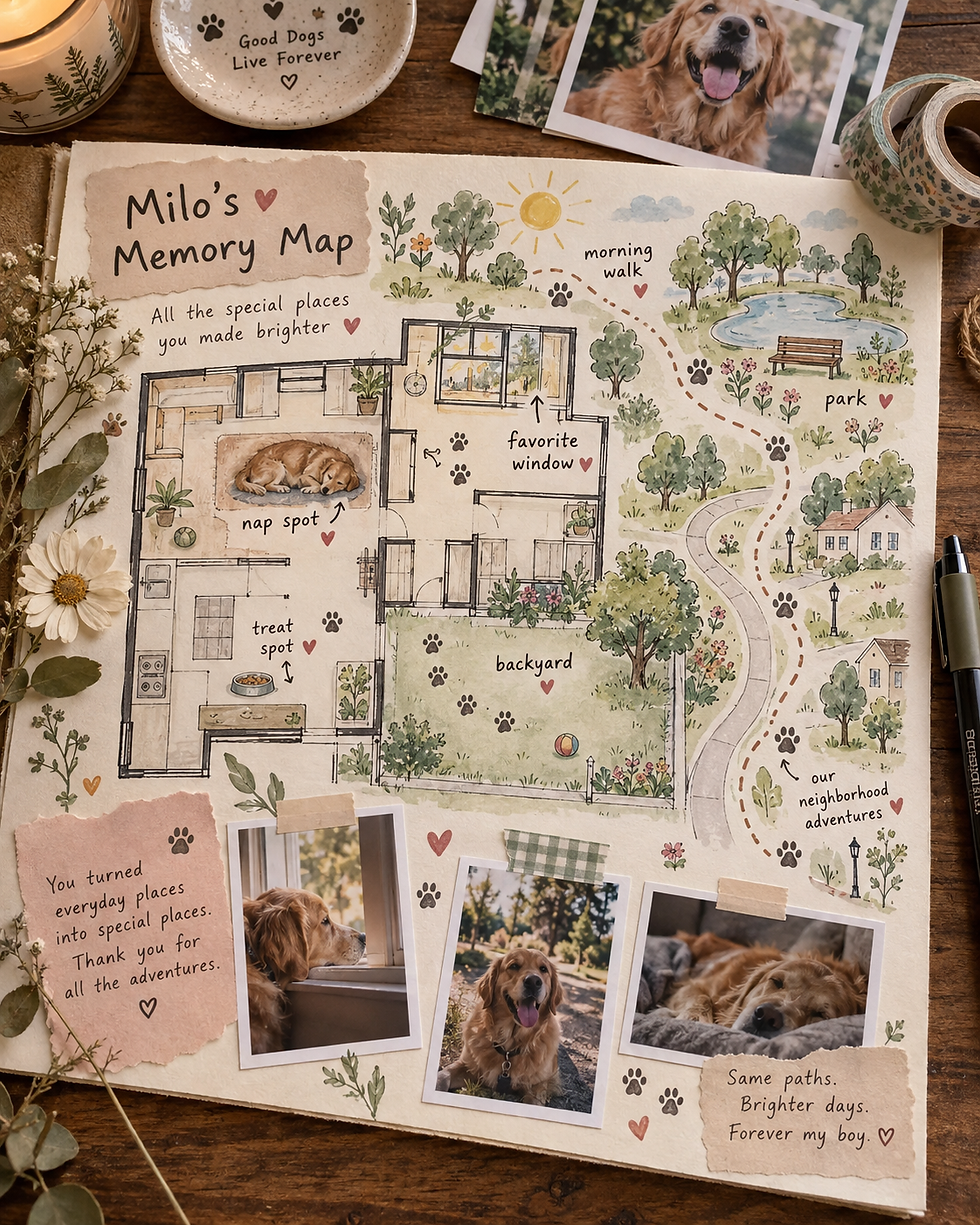
You can draw or print a simple map of your home, neighborhood, town, or even several places your pet knew, then mark the locations that hold meaning.
It does not need to look professional.
It does not even need to look like a traditional map.
The purpose is simply to create a visual record of the places that became part of your life together.
Pet Memory Map Ideas at a Glance
Place to Include | Memory You Might Record | What You Could Add |
Favorite sleeping spot | Where they always curled up | Small heart or paw print |
Favorite window | What they watched outside | Tiny drawing of a bird |
Walking route | Regular morning or evening walk | Dotted path |
Park | Favorite place to explore | Tree or bench symbol |
Backyard | Where they played or rested | Photo or pressed flower |
Kitchen | Where they waited for treats | Small food bowl drawing |
Front door | Where they greeted you | Paw print |
Couch | Favorite family resting place | Short written memory |
Vacation spot | Trip you took together | Photo or date |
Vet or adoption location | Important part of their story | Name and date |
Car route | Favorite rides | Small car symbol |
Memorial garden | Place you now remember them | Flower or plant drawing |
What Is a Pet Memory Map?
A pet memory map is a visual way of recording the places associated with your pet.
Instead of writing memories only in chronological order, you organize them by location.
For example, a map of your house might show:
The bed where your dog slept
The kitchen spot where they waited for food
The sunny window your cat loved
The hallway where they chased toys
The couch where you sat together
A neighborhood map could include:
Your regular walking route
A favorite park
A neighbor they always stopped to see
A pond or trail
A pet-friendly café
The corner where they always insisted on turning
The map becomes a visual reminder that your relationship was built from hundreds of ordinary places and routines.
Why Make a Memory Map After Losing a Pet?
When someone talks about creating a pet memorial, the first ideas are often things like:
Urns
Memorial stones
Photo frames
Jewelry
Gardens
Those can all be meaningful.
But sometimes what you miss most is not an object.
It is the routine.
Where they sat.
Where you walked.
Where you waited together.
Where they made you laugh.
Creating a memory map gives those ordinary places a place in your memorial.
If you're looking for other ways to remember your pet through small meaningful actions, you may also like Pet Loss Rituals You Can Do in 5 Minutes.
1. Decide What Kind of Map You Want to Make
Start by choosing the area you want your map to cover.
You might create a map of:
Your home
Your yard
Your neighborhood
Your town
A walking trail
Favorite vacation locations
Several places connected to your pet
Your map can be extremely simple.
For a home memory map, you might sketch the rooms from above.
For a neighborhood map, you could draw the main streets.
If you do not enjoy drawing, print a basic map and add your memories on top.
2. Start With Your Home
Home is often the easiest place to begin because so many pet memories are tied to everyday routines.
Walk mentally through each room.
Ask yourself:
Where did they sleep?
Where did they wait for food?
Which window did they look out?
Where did they hide?
Where did they bring toys?
Where did they sit while you worked?
Where did they greet you?
Add those places to your map.
They do not need long descriptions.
A few words may be enough.
For example:
Kitchen doorway — waited here every night while I cooked.
or:
Living-room window — watched squirrels every morning.
Those small details are often the ones we miss most.
3. Map Your Favorite Walking Route
If you had a dog, walking routes may hold especially strong memories.
Draw or print the route you took most often.
Then mark places such as:
Favorite sniffing spots
A particular tree
A neighbor's house
A bench
A pond
A hill
A place where you often stopped
You might even mark the places where your dog always behaved in a very specific way.
Maybe they always pulled toward one yard.
Maybe they stopped at the same tree.
Maybe they refused to walk past a certain street.
Those details can become part of the map.
4. Add the Places They Loved
Think beyond your home.
Did your pet have a favorite:
Park
Beach
Trail
Lake
Backyard corner
Pet store
Family member's house
Vacation destination
Car ride
Mark those places too.
You can create one large map or several smaller ones.
For example:
Our Home
Our Walks
Places We Went Together
Together, they can tell a much larger story.
5. Include Favorite Indoor Spots
Cats especially may have very specific favorite places around the house.
You could mark:
Sunny windows
Radiators
Beds
Chairs
Shelves
Stairs
Closets
Laundry baskets
Boxes
Kitchen counters
A simple house floor plan can become surprisingly meaningful once these locations are added.
You may even realize how much of your home was quietly shaped around your pet.
6. Add Small Symbols
You do not need to write paragraphs everywhere.
Use symbols to make the map more visual.
For example:
🐾 Paw print: favorite location
❤️ Heart: especially meaningful memory
⭐ Star: funny or unforgettable moment
🌳 Tree: favorite outdoor spot
🌸 Flower: memorial location
☀️ Sun: favorite sunny place
You can create your own legend at the bottom of the page.
7. Add Photographs
If you're making a larger memory map, add small photographs beside important locations.
For example:
A photograph of your dog at the park.
A picture of your cat sitting in their favorite window.
A photo from a vacation.
A picture of them curled up on the couch.
This can turn a simple map into something closer to a scrapbook page.
If creating something physical helps you process memories, you might also enjoy Why Making Something Can Help After Pet Loss.
8. Write One-Sentence Memories
You do not need to tell the entire story.
Write one sentence beside each location.
Examples:
You always stopped here to smell the flowers.
This was your favorite place to nap in the afternoon.
You waited at this door every day when I came home.
This is where you first learned to sit.
You always tried to chase the ducks here.
Short memories keep the map from becoming overwhelming.
9. Add Dates If They Matter to You
Some memories may have specific dates attached to them.
You could include:
Adoption day
Moving day
First walk
First vacation
Birthday
Final walk
A special trip
Dates are optional.
If they make the map feel too formal or too focused on time, leave them out.
The memory itself is enough.
10. Turn the Map Into a Journal Page
A memory map does not have to become wall art.
It can simply live inside your journal.
Create a two-page spread.
Use one page for the map.
Use the other for writing.
You could answer prompts such as:
Which place do I miss seeing them most?
What ordinary routine do I remember most clearly?
Which place makes me smile?
Where did they seem happiest?
What place feels different now?
If journaling is already part of your grief process, you might also like Pet Loss Journal Prompts or your other pet loss journaling resources.
11. Make a Memory Map of Your Yard
If your pet loved being outside, create a separate yard map.
Mark:
Favorite sunny spot
Favorite tree
Place they dug
Fence they watched through
Garden they explored
Spot where they slept outside
Place where they chased toys
If you have created or are planning a remembrance space outdoors, you can also mark your pet memorial garden.
For more ideas, see The Ultimate Guide to Creating a Pet Memorial Garden.
12. Add Sensory Memories
You can make the map even more personal by adding sensory details.
For each location, ask:
What did I hear here?
Maybe tags jingling, barking, purring, birds, or leaves.
What did I see?
Sunlight, muddy paws, fur on the couch, a favorite blanket.
What did I feel?
Warm fur, a leash in your hand, paws beside you.
What did I smell?
Wet grass, shampoo, treats, flowers.
This can make the memories feel more vivid.
13. Use the Map as a Memory Prompt
Once your map is finished, it can become a source of future journal prompts.
Choose one place at a time.
Then write about it.
For example:
The kitchen
What did they do while you cooked?
The window
What did they watch?
The park
What happened on your favorite walk?
The couch
What did an ordinary evening together look like?
One map can generate dozens of memories.
14. Create a Digital Memory Map
You do not have to make the project on paper.
A digital version could include:
Photos
Labels
Small icons
Written memories
Dates
Different colors
You could create one in Canva or another design program.
A digital version is also easy to save, duplicate, or print later.
15. Make the Map Part of a Memorial Shelf
If you have a memorial shelf or small remembrance area, consider framing the finished memory map.
Place it beside:
A photograph
Collar
Paw print
Candle
Small keepsake
Favorite toy
A map can be especially meaningful because it represents the life you shared rather than only the loss.
If you're building a remembrance space at home, you may also like your article about creating a pet memorial shelf.
Turn the Map Into a Memorial Walk
Your memory map can also inspire an activity.
Choose one of the outdoor routes you marked.
Walk it again.
You do not need to recreate the experience exactly.
Simply notice the places you remember.
Stop at the tree.
Sit on the bench.
Walk past the house they always stopped at.
It can become a simple remembrance ritual.
For another gentle way to combine memory and quiet reflection, see How to Add Meditation to a Pet Memorial Garden.
Create a Map With Other Family Members
Your memories may not be the same as someone else's.
Ask family members:
Where do you remember them most?
One person might immediately think of the couch.
Someone else might remember the backyard.
A child may remember a particular hallway where they played.
Adding everyone's memories can make the map feel more complete.
What If Making the Map Feels Too Difficult?
You do not have to finish it all at once.
Start with one place.
Draw one room.
Add one paw print.
Write one sentence.
Then put it away.
You can return to it when you want.
Grief projects do not need deadlines.
A Memory Map Can Keep Ordinary Moments From Disappearing
Large memories are often easier to remember.
Adoption day.
Vacations.
Birthdays.
The final days.
But much of the relationship you shared with your pet probably happened in much smaller moments.
Walking the same street.
Sitting on the same couch.
Opening the same door.
Watching them nap in the same patch of sunlight.
A memory map gives those ordinary places a place to live.
Draw your home.
Trace the walking route.
Mark the park.
Circle the window.
Write down the little things you remember.
Because sometimes a place that looks ordinary on a map holds an entire story.

Comments